The Field Sketch Before the Photograph
A field sketch records relationships a quick photo can miss, helping University of Science students preserve orientation, context, and what they actually observed.
A student beside a stream raises a phone toward a patch of moss, then pauses: the image will show the green surface, but not why it caught their attention. A field sketch for University of Science students at VNU-HCM can record that choice. It is not an artistic substitute for a photograph; it makes an observation visible while the place is still in front of them.
That distinction matters in fieldwork, where light shifts, landmarks disappear behind a passing group, and a camera captures more than a notebook can explain. Drawing asks the observer to choose what belongs in the record. Brief labels and orientation marks can preserve relationships that a quick image may leave ambiguous.
Why Sketch in the Field?
A field sketch turns looking into a sequence of decisions. The student identifies a feature, locates it among other features, and marks what seems relevant. Even a rough outline can show that a plant grew below a ledge, that a sample came from the shaded bank, or that a visible boundary ran across the slope rather than along it.
A photograph often keeps surface detail and color well, but the frame does not explain what the observer intended to examine. A sketch can be selective: it can leave out distractions and make a relationship prominent. Its usefulness comes not from neatness but from the record of attention it provides.
Naturalists, geologists, and surveyors have used drawings to preserve features that were difficult to carry back to a desk. Sketching asks a person to inspect a scene closely and decide how to communicate it. That habit remains useful when a phone is available: the drawing captures a working interpretation, while the photograph preserves a visual reference.
What a Sketch Preserves
A deliberate sketch can preserve spatial context: which object was beside another, where a feature sat in relation to a trail, or how a surface changed from one edge to the next. It can also record orientation and the boundary of the area being observed. These details help a later reader understand where the observation came from, rather than seeing an isolated object with no setting.
Annotations make the drawing more than a picture. A short note can distinguish what was seen from what is inferred: “dark band on exposed rock” describes an observation; “possibly damp” signals an interpretation. Arrows can point to a feature without requiring a detailed rendering. A north arrow or a simple “upstream” mark can clarify direction, while a note about shade or recent rain can preserve conditions that may change before the next visit.
Keep the drawing selective. A crowded page can bury the relationship it was meant to preserve. Choose a few visible landmarks, mark the focal feature, and add only the labels needed to make the arrangement legible later.
How to Annotate Field Notes
Start with information that anchors the sketch to a place and moment: site name or location description, date, observer, and a brief description of the subject. Add orientation when direction matters, then label important features in plain language. If an estimate is approximate, say so rather than letting a clean line imply more certainty than the observation supports.
Use a pencil and a notebook that can lie open comfortably; a waterproof field notebook may suit damp sites, while ordinary paper can work in dry conditions. A clipboard helps on a windy path, and a phone photo can supplement the drawing. Keep labels close to their features, but avoid placing text over the part of the scene it describes.
- Location: Check whether the site name or a recognizable landmark is written down. If it is, keep it; if not, add a location description before leaving, or record the nearest identifiable landmark if the site name is unknown.
- Orientation: Check whether direction affects the observation. If it does, mark north, upstream, or another useful direction; if it does not, leave the sketch uncluttered and omit an irrelevant arrow.
- Scale cue: Check whether size matters to the question. If it does, add a ruler, known object, or clearly stated estimate; if no reliable cue is available, state that scale is unknown rather than implying precision.
- Conditions: Check whether shade, moisture, weather, or visibility could change the appearance. If so, note the relevant condition; if not, omit unrelated detail and keep the page focused.
- Observation: Check whether a label describes something directly visible. If it does, mark it as an observation; if it is an inference, qualify it with wording such as “possibly” or keep it separate from the visible description.
- Connection: Check whether the relation between features matters. If it does, connect them with an arrow or short note; if it does not, keep them as separate labels and avoid suggesting a relationship.
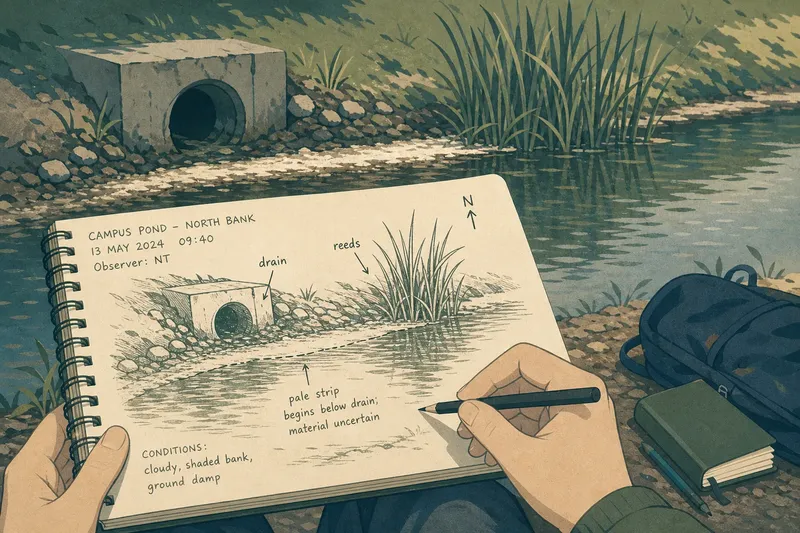
Say a student at a campus pond notices a narrow strip of pale material along the water’s edge. The starting inputs are the visible shoreline, a nearby drain, a clump of reeds, and uncertainty about what the material is. The student draws the shoreline, marks the drain and reeds, then writes, “pale strip begins below drain; material uncertain.” The resulting page shows the strip’s position and preserves the uncertainty, rather than turning a first impression into a settled identification.
Sketch or Photograph?
A sketch is useful when the question concerns arrangement, boundaries, or the observer’s choice of focus. It can simplify a tangled scene and show which details mattered. A photograph is often better for retaining fine texture, color variation, or an appearance that would be hard to draw quickly. Neither format replaces the other in every setting.
Use both when they answer different questions. A photograph can serve as a visual reference, while a sketch can explain where the relevant feature sits and what to inspect in the image. If only one record is practical, choose according to purpose: preserve fine visible detail with an image, or make relationships and decisions explicit with a drawing.
Questions About Field Sketches?
Does a field sketch need to look accurate?
It needs to be clear enough for its purpose, not polished. A simple outline with careful labels can communicate position better than a finely shaded drawing that omits direction or context.
Should I draw before taking a photo?
Draw first when making the sketch will help you decide what matters before the scene changes or your attention shifts. Take a photo as well when surface detail or color will be useful for later comparison.
How do I mark an uncertain identification?
Describe the visible feature and mark the identification as tentative, using wording such as “possibly” or a question mark. Keeping observation and interpretation distinct lets a later reader reconsider the label without losing the original detail.
What if the site is hard to draw?
Reduce it to a few landmarks and the relationship you need to record. A boundary, arrow, and short note can carry the useful information without trying to reproduce every feature.
How the Record Travels
A field sketch earns its place when someone can read it away from the site. Before leaving, check that labels are legible, orientation is clear, and the page identifies what was observed. If a photograph accompanies the drawing, give the image a matching note or identifier so the two records can be connected later.
For University of Science fieldwork, a useful field sketch is not the one that resembles a finished illustration. It is the one that lets a classmate—or the same student on another day—return to the observation and understand where to look, what was noticed, and what remains uncertain. A few honest marks can preserve the question that made the scene worth recording.