How to Trace Claims in a Science Figure
Trace claims in a science figure by linking each statement to its source, caption, and cited visual evidence, so your notes preserve what the figure supports.
You open a journal PDF beside a biology handout and find the same figure discussed in two different paragraphs. To trace claims in a science figure, follow each statement back to the source text and the exact panel or feature it cites; a caption alone cannot tell you what the author is arguing.
At the University of Science, Vietnam National University Ho Chi Minh City, course materials may pair figures from papers, textbooks, or lab manuals with explanations written for a particular question. Your job is not simply to describe the image. It is to keep the source, the author’s claim, and the evidence cited for that claim connected in your notes.
Trace the source figure
Start with the figure number, panel letter, caption, and document title. If a handout reproduces a figure from another source, note both the handout page and the original citation when available. That distinction matters: a course author may select or crop a figure, while the source paper supplies the methods and context that explain it.
Keep the materials side by side. In Adobe Acrobat or Preview, add a comment containing the figure and panel reference; on paper, write the same reference beside your note. Do not rely on a vague description such as “the graph on the right,” which becomes hard to identify after pages are rearranged.
Follow claims to panels
Find the sentence that cites the figure, then identify the specific panel, label, or visual feature it invokes. A paragraph may use one panel to describe a pattern and another to compare conditions. Record the author’s wording separately from your description of what the cited panel visibly contains.
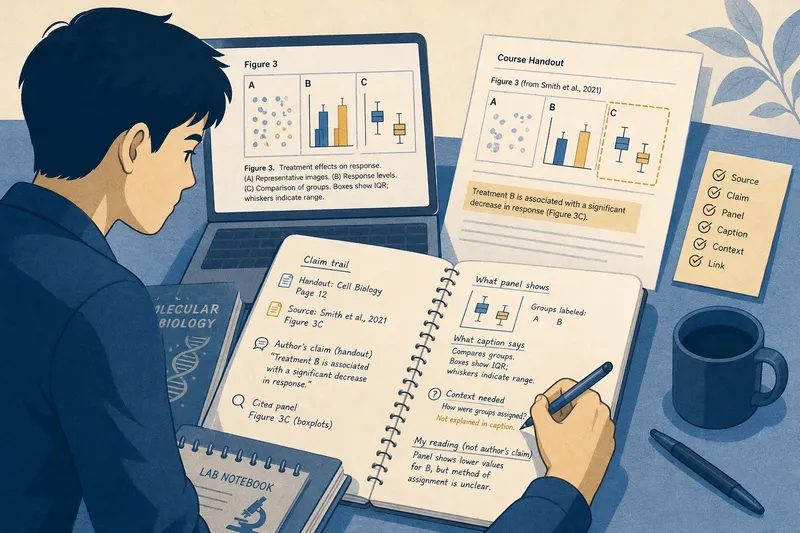
Say you are reading a handout that reproduces Figure 3 from a paper, and its paragraph claims that treatment B is associated with a change shown in panel C. You write down the handout page, the paper’s Figure 3C reference, and the claim in the author’s words. Then you check the original caption and find that panel C labels the groups but does not explain how they were assigned; your note therefore links the claim to the cited panel while leaving the assignment method unresolved, rather than treating the image as an account of the full method.
Check source context
Captions, methods, and surrounding prose answer different questions. A caption may identify what a panel depicts; the methods may explain how the material was prepared or compared; the results text may state which pattern the authors consider relevant. Follow the citation trail far enough to locate the context needed for the claim you are recording.
- Figure identity: Check the figure number and panel letter; if they match the cited source, record them, but if they do not, compare the handout and source versions before attributing the claim.
- Caption scope: Check what the caption names; if it defines the groups or conditions relevant to the claim, include those terms, but if it omits them, consult the cited methods or mark the context as missing.
- Claim wording: Check the sentence that refers to the figure; if it makes a specific claim, quote or paraphrase that claim with its location, but if no sentence connects the figure to an argument, describe the figure without assigning it one.
- Panel reference: Check whether the author cites a whole figure or a particular panel; if a panel is named, inspect that panel, but if the reference is broad, avoid attributing details from one panel to all of them.
- Source version: Check whether the handout cropped, relabeled, or rearranged the source figure; if it differs, note the change and use the original source for context, but if the original is unavailable, identify the handout as your source.
- Evidence link: Check which visible feature the text uses to support its statement; if the connection is explained, record the feature and the claim together, but if it is not, flag the missing link rather than supplying an explanation yourself.
Keep a claim trail
A traceable note gives another reader a route back to the source. Include the document or handout title, page, figure and panel reference, the claim being discussed, and the caption or passage that provides context. Use quotation marks for exact wording; label your own reading so it cannot be mistaken for the author’s statement.
If the prose and figure appear to conflict, record both locations and the specific mismatch. A course instructor or an assigned reference can help determine whether the difference comes from a changed figure, a condition described elsewhere, or an unresolved inconsistency. Until then, leave the conflict visible in your notes.
Questions about source claims?
What if the handout changes a figure?
Compare its labels, panels, and crop with the cited original, then note any difference that could affect the claim. If the original is unavailable, identify the handout as the source you actually consulted and leave uncertain context unresolved.
How much of the source should I read?
Read the caption and the passage that makes the claim, then consult the methods or other cited context if the statement depends on how groups or conditions were defined. Stop when you can identify the claim and its cited evidence, or record what remains unavailable.
What if a claim cites several panels?
List each panel separately and note which part of the sentence it is meant to support. If the text does not make those links clear, mark the ambiguity instead of assuming that every panel supports every part of the claim.
Can I paraphrase the author?
Yes, but keep the paraphrase distinct from your own description of the figure and retain the source location. If the wording is central or easy to misstate, quote the relevant phrase and identify it as the author’s language.
When you revisit a figure, a precise citation trail saves you from relying on memory: the source, page, panel, and claim let you reopen the same evidence and see exactly where the author’s interpretation begins.